“There’s a way to make this work, if you really want it to.”
*Image made with AI*
(specifically, orginizing the data and honing in on the idea to polish it to be more attrative and easier to understand from multiple perspectivces, full conversation is below)
My Favorite part in the ai summery:
Then instead of one cheesy leaderboard number, you'd have something more like an epistemic résumé:
Information discovery: 94
Calibration: 91
Disconfirming evidence found: 97
Evidence reliability: 95
Procedural fairness: 92
Disclosure integrity: 100
Now the prestige competition becomes fascinating. Lawyers start bragging about being excellent reality detectives, not just excellent combatants.
Its interesting because the only people who wouldn’t want this…
The people mentioned in this area, I don’t wish any of them ill will, they were just used as an example because it was a very clean easy to understand example for this educational/social commentary. I truly wish both parties get the help they need. Be cool, Godbless.
Conversation Start
(it start with a voice to text transcript)
Hello can you help me make this message more coherent, put the main points in the right order that makes the nost sense to understand whats happening, and make it sound professional please: So it's like this. Better legal system 2.0. So right now, this isn't like a, oh, the system's broken, all these things. It's like, okay, um, when you have a legal system that isn't fundamentally based off of looking at what happens and acting accordingly, inevitably the two sides are going to silo information in a way that benefits their side and not the others. So that is what's happening. So fundamentally, you have something where they're incentivized to keep things from each other, unless out of the goodness of their hearts they don't and they reveal information that would hurt their clients. But that doesn't really, like, do you see? Okay, so how can we make something that would benefit everybody, including the people outside of this society? Because again, it's, well, I guess we don't have to go into specifics, but basically, if you have a system, if instead you have a system where the two lawyers, or maybe even just one or something, they just figure out what happened. That's it. They, like, they both or just one or the judge or whatever, that they just figure out, well, what the crap happened? And how does this person feel about it? And how to act accordingly to create a decision that works for both sides, right? So if you just look at, like, okay, like, what actually just happened, and a way for them to curry favor on their side is to have an apologetic understanding that actually makes sense to whoever the jury is or the judge or something. Because then you have a system where even if someone pretends to have an apology, it really doesn't matter because a lawyer would be working with them at least to ask them Socratic questions to get them to understand, like, hey, do you understand, like, this is not, like, you can't just do this and stuff? Versus, you know, like, they have to sit, like, they still might go to jail, but it would just be less jail time where they can sit with that understanding that they just either faked or thought was real. Because then it's like people actually have a, they're incentivized to sympathize and understand the other side, or at least repeat a fake understanding, which as we know, psychologically, would still have an effect on people by just simply them or their lawyer trying to get them to repeat the understanding and memorize it to some extent. That that would still have some sort of psychological effect on them. That's a much better system than what's happening now, I think. I would be surprised if someone disagreed with that. Oh, and then the lawyers, they could argue, well, this piece of, like, that, they could just argue that this piece of information is not entirely, like, how substantial this piece of information is relevant to their client. And like, would, because, like, with the prosecutor and defenders, like, they have such a huge incentive to just be like, oh, no, they're like a good person or, like, whatever. That if you just look at, okay, well, what happened, is this piece of information, like, not so much relevant, but does it, actually, yeah, like, how relevant is this information piece? Figure out what happened. Is there a moment in time where there's, like, they can say some sort of apology to curry favor? It's like, okay, well, at least they understand it, so we can reduce the time a little bit, or whatever the punishment is by a little bit. Unless it seems, like, really genuine, then it's like, oh, okay. Because if they came with it on their own, then, you know. But then, you know, that would require the lawyers not having to... But anyway. So I think that that would at least, it uses the system to incentivize an apologetic understanding, I think, a little bit better than what's happening now. Because even, like, the idea of sides, like, I think that's a little bit weird. Because then it gets into people thinking, like, win or lose, which I think if your lawyers thinking about winning or losing something, they're missing the point of, does, is this, like, it's like, is this gonna benefit, like, is this actually good for the people in this society, like, to be treated like this? Or, like, it's like... But anyway. Because if you're thinking about win or loss, it's like, is this good for this person to be treated like this? Like, is this helping, like, anything or anyone? And then so, like, at least with the apologetic understanding, it would, it could provide, it would at least help get the wheels turning in that direction, more or less. But, yeah.
Absolutely. I’d structure it around one central idea: replace adversarial incentive with truth-finding plus restorative understanding, while still preserving accountability.
Better Legal System 2.0
The idea is not that the legal system is simply “broken.” The deeper issue is that an adversarial structure naturally encourages each side to organize information in the way that best benefits its own position.
When both sides are rewarded for winning, they have an incentive to emphasize favorable facts, minimize unfavorable ones, and frame the same event in competing ways. Even when everyone is acting professionally and ethically, the structure itself can still push people toward information silos.
A different model could begin with a simpler question:
What actually happened?
Instead of treating the case primarily as a contest between two opposing narratives, the central purpose would be to reconstruct the event as accurately as possible, understand how each person experienced it, and determine what response would create the best outcome for the people involved and for society.
Lawyers could still challenge evidence and argue about its importance, but their role would shift somewhat. Rather than mainly arguing that a fact helps or hurts their side, they could debate questions such as:
How reliable is this information?
How relevant is it to what happened?
How much weight should it carry?
What does it tell us about intent, harm, responsibility, or future risk?
What response would most effectively repair harm and prevent repetition?
Another important part of the system would be what I would call apologetic understanding.
If someone caused harm, part of the process could involve demonstrating that they understand what happened, why it affected the other person, and what they could have done differently. Genuine understanding could potentially influence sentencing, rehabilitation, restitution, or other outcomes.
Even when that understanding begins somewhat mechanically, the process of having to explain another person's perspective, answer Socratic questions, and repeatedly articulate the consequences of one's actions may still encourage reflection.
The point would not be to replace accountability with apology. Someone could fully understand what they did and still receive punishment. Rather, demonstrated understanding could become one factor in determining what kind of response is most appropriate.
This changes the incentive structure.
Instead of being rewarded only for denying, minimizing, defending, or defeating the opposing side, people would also be rewarded for accurately understanding the event and the people affected by it.
The broader principle is that the legal system should not primarily ask:
Who wins?
It should ask:
What happened, what harm occurred, what does each person understand now, and what response produces the best realistic outcome from here?
A justice system built around those questions could preserve evidence standards, due process, legal advocacy, and accountability while creating stronger incentives for truth, understanding, rehabilitation, and repair.
In that sense, Better Legal System 2.0 would not eliminate disagreement or legal representation. It would change what the system is ultimately optimizing for: not victory between sides, but the most accurate understanding of what happened and the most constructive response to it.
One nuance I’d preserve if you develop this further: the adversarial system also exists partly because we cannot assume a supposedly neutral truth-finder will actually be neutral. So your strongest version probably isn’t “remove the two sides,” but keep independent advocates while changing the reward function of the whole system. That makes the idea much harder to knock over.
I'd even add a little bit, I'd even add this little piece to it. So can you also like summarize this piece? You don't have to rewrite the whole thing, just add this as like a separate summary where it's like, okay, so lawyers, they still want to be incentivized for something, and they still can be. They could be incentivized by who has the highest Fisher information piece of information that they're bringing to the table. And that could be something like super, super obscure, some like obscure fact or something that really, that heavily biases the information in a particular way. That would make more sense because then you're kind of encouraged on both sides to figure out like, well, one, like what exactly happened. And again, I guess both sides wouldn't be a great way of saying this because I guess the two sides are still working together. And then you just say, like, this is what happened, and then they ask you questions and ask you questions and stuff. And I guess that asking questions would have to be documented to make sure that it's all relevant and stuff. But as that gets, figure out like just like what the crap happened, the lawyer to have the best Fisher information case, I mean, have the best Fisher information, so like the information density. So like, I guess like in the Amber Heard or Johnny Depp trial, it would be like the CAS-36 given to Amber Heard during the trial. That's more important than everything else because then you see with that CAS-36, she's behaving in all these (**edited out**: not entirely pleasant) ways that they're describing, like on that piece of paper. And I feel like that was kind of like skipped more or less, like it was just like another thing when it's like, that's kind of like the whole thing where it's like, oh, well, like that's just a predictive model of exactly what she's doing. So like that's, like whoever thought about giving her that test. But then the issue, like I guess it would be like, well, how do people know that a lawyer does that? Well, I guess people don't really know now, you know, so that would actually probably be better if there's a way to like, they're like, oh, this lawyer actually, they're like thinking like about obscure facts that can add more interesting information to his story. And then they could just kind of get based off of that, like that's like ranked on like a scoreboard or something. Or it's like information that people are like, that it's like pretty inarguable, like it's like, oh, like that's, you know. But, yeah. Something like that.
Yes. I’d summarize this as a new incentive layer for lawyers based on information value rather than adversarial victory.
Separate summary: Information-Value Incentives for Lawyers
Lawyers would still need something to compete over, but instead of being rewarded primarily for “winning,” they could be rewarded for identifying the highest-value piece of information in a case.
The idea is that some evidence carries far more explanatory power than other evidence. A single obscure fact, test result, document, timeline detail, or behavioral pattern might dramatically change how the entire case is understood. Lawyers could be recognized for finding those high-information-density facts and showing clearly why they matter.
You could frame this using the idea of Fisher information, though technically Fisher information has a specific statistical meaning, so for a legal framework I would probably call it something like:
Information Value
How much a piece of evidence reduces uncertainty about what actually happened.
Or:
Evidence Information Density
How much explanatory or predictive value a piece of evidence contributes relative to everything else in the case.
That would change the incentive from:
“How do I make my side look better?”
to:
“What piece of information most sharply improves our understanding of reality?”
Both lawyers could still investigate aggressively, ask difficult questions, and search for obscure evidence, but they would effectively be collaborating on the reconstruction of the event. The competitive element becomes who contributes the clearest, strongest, most uncertainty-reducing insight.
Questions and investigative steps could also be documented so that the court can see how a conclusion was reached and whether each line of inquiry was relevant.
You could even imagine a professional record showing that a particular attorney repeatedly discovers unusually important evidence. Their reputation becomes:
“This lawyer finds the thing everyone else missed.”
I think that actually strengthens your larger concept quite a bit because it preserves something useful about competition. You’re not trying to remove competitive intelligence from law. You’re redirecting it toward truth-finding instead of narrative combat.
I think you actually can. I see where you're going, and I think that that would be interesting to go in that direction, where it's like to keep independent advocates while changing the reward function of the whole system. I think that is good, but I think you actually can do the neutrality. Like, the neutral truth finder will actually be neutral by basing it off of the, what did the clients both say about each lawyer at the end of the trial? So if there's like complaints or something, that would kind of say a little bit more. Because then if the client says, well, this lawyer didn't think about this, or they didn't account for this, this, and this, that says a lot about the lawyer, versus if something, even if something happened and it's not in someone's favor, they could be like, oh, well, that's actually like a fair outcome. And then, of course, you might say, oh, well, like the person might lie about the review of the lawyer within this specific case, but that actually doesn't matter because if you look at all the information within the case, then you can see, like, if someone is like Amber Heard, and like, at some points, like, obviously lying about, like, we know kind of for a fact she was obviously lying about specific parts [Notes added later: scored in 98 percentile for exaggerating PTSD, so the test said she exaggerated it extremely, which to be fair exaggerated doesn’t mean its all made up. But the crux of the matter is you have a person who scored 98 percentile, willingly exaggerated her PTSD on a test that would be used in court of law… How exactly does that benefit her? And that’s the issue, it wasn’t really pressed on the why did that happen in relation to the other psychological findings, the lawyers could argument on the importance of the CAP-5 and other phycological test because it seems important, that they already exaggerated on a test that was used as evidence in court… when the whole trial was based on “Yes. Legally speaking, Johnny Depp's entire defamation lawsuit was built on the claim that Amber Heard's allegations of domestic abuse were a hoax and a lie, which severely damaged his reputation and career.” i’m not necessarily picking sides, but objectively, that seemed kind of like a major shoo-in, that didn’t really have as big of an emphasis as I thought it would. And Jonny could take the same test(s) she did and they can just compare notes. But supposes his scores are better, it doies’t really seem like that evidence would be put into the trial. Because the sides want to win, where with this lawyer/law update, the lawyers win no matter what, and the people can review the lawyers results to see how happy they were even if they don’t like the outcome, but think its fair, or get it appealed]. If she says, well, this lawyer brought up some test I took and like, all this other stuff, and it's like, that test is pretty, like, pretty certified. So it's like, obviously this person is the liar, essentially, because it's like, this test, like, can't really be incorrect. At least the psychologists are like, well, you know, it's pretty freaking accurate. And given that she was behaving the same way in the case, it seems unlikely that it just so happened to fail for this time. And that isn't, like, there's ways to prove neutrality based off the outcome of the results and like what people said about the two lawyers and everything. And I think that actually is possible to do it like that.
But with that being said, like, how would you suppose the reward system could be changed to make better incentives for finding information? Oh, well, I guess that whole scoreboard is pretty good, but if you have anything else, just, you know, let me know, if you can think of anything. Or if there's anything out there.
Yes. I think your client-feedback idea can absolutely be part of the neutrality test, especially because research on procedural justice finds that people can view a process as fair even when they dislike the outcome. Courts already think about procedural fairness through things like whether people had a voice, whether decisions appeared neutral, whether they were treated respectfully, and whether they trusted the decision-maker. (Conference of Chief Justices)
Where I would modify your idea is this: client reviews should be one sensor, not the whole measuring instrument. A losing client saying “I hated the result, but the lawyer listened to me, investigated what I raised, and the outcome was fair” is extremely informative. But an angry review by itself does not prove bias, just as a glowing review does not prove neutrality. Existing judicial-performance systems use behavior-based surveys, but they combine observations rather than treating one person’s satisfaction as definitive. (American Bar Association)
I think you can build a much more interesting reward system around this:
Information-Gain Score. Reward the lawyer for evidence that genuinely reduces uncertainty about what happened. An obscure fact could score enormously if it changes the probability of competing explanations, while 500 repetitive facts could score almost nothing. I’d actually call this information gain rather than Fisher information unless you build a formal statistical parameter model, because Fisher information has a narrower technical meaning tied to how well observations distinguish values of a model parameter. (Department of Statistics)
Disconfirmation Bonus. Give lawyers extra credit for finding important evidence that contradicts their own current theory. That is the juicy one. If I get rewarded for discovering that my hypothesis was wrong, suddenly hiding uncomfortable evidence becomes economically stupid. Current legal ethics already contain fragments of this philosophy: prosecutors are formally told their role is to seek justice rather than merely convictions, lawyers may not obstruct access to evidence, and lawyers have duties of candor toward tribunals. (American Bar Association)
Calibration Score. Before investigating something, the lawyer could privately record probabilities such as “70% chance X happened.” Later, when evidence resolves the question, you track how calibrated that lawyer is across hundreds of judgments. Statistics already has proper scoring rules, specifically designed so people maximize their expected score by honestly reporting their probabilities rather than gaming them. (Taylor & Francis Online)
Question-Quality Credit. Document the investigation tree: What did you ask? Why did you ask it? What competing explanation were you testing? Then reward lawyers who repeatedly ask questions that produce high-value evidence. That means the professional reputation eventually becomes less “this person wins 86% of cases” and more “this person is unusually good at finding out what actually happened.”
Independent Corroboration Score. Evidence gets more value when independent sources converge on it. A lawyer who finds three genuinely independent lines of evidence pointing toward the same event gets more credit than somebody presenting the same allegation fifteen different ways.
Disclosure Score. Reward early voluntary disclosure of important information, including information unfavorable to the lawyer’s working hypothesis, while heavily penalizing concealment. Civil discovery rules already require disclosure and allow sanctions for failures to cooperate, so this would be an incentive redesign layered over something the legal system already partially does. (Legal Information Institute)
Procedural-Fairness Score. Afterward, ask both people questions such as: Did the investigator understand your account? Did they seriously pursue information you thought mattered? Did they explain why evidence was accepted or rejected? Do you understand how the conclusion was reached? Do you consider the process fair even if you dislike the result? That last question is particularly powerful for exactly the reason you identified. Procedural-fairness research suggests unfavorable outcomes can still be accepted more readily when people believe the process itself was fair. (Bureau of Justice Assistance)
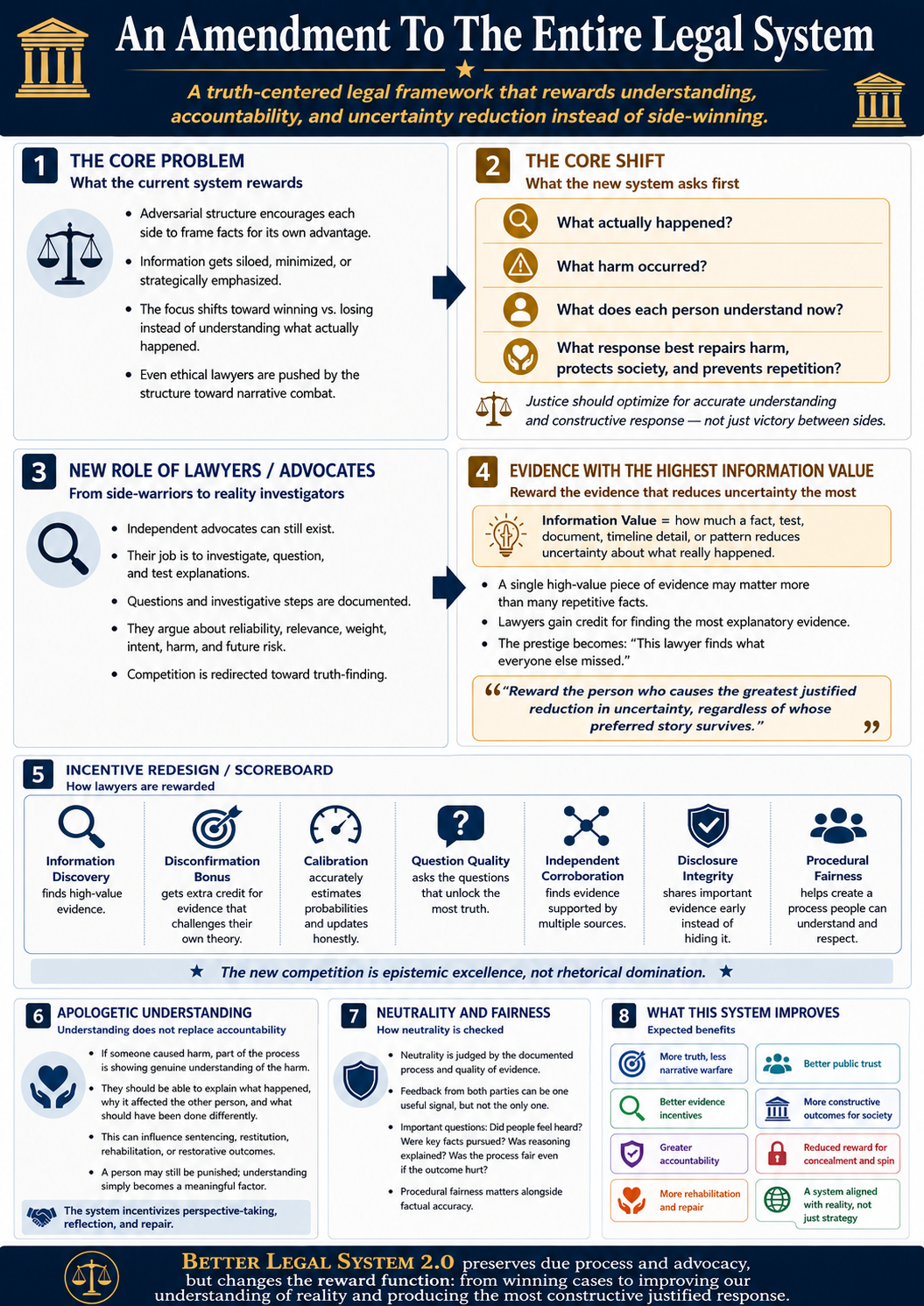
Then instead of one cheesy leaderboard number, you'd have something more like an epistemic résumé:
Information discovery: 94
Calibration: 91
Disconfirming evidence found: 97
Evidence reliability: 95
Procedural fairness: 92
Disclosure integrity: 100
Now the prestige competition becomes fascinating. Lawyers start bragging about being excellent reality detectives, not just excellent combatants.
And there is actually legal scholarship surprisingly close to the direction you're wandering into. Keith Findley proposed an “Adversarial Inquisitions” model that tries to combine useful aspects of adversarial representation with a more truth-oriented investigative structure. So your instinct that the binary choice “adversarial system OR neutral truth-finder” might be false already has cousins in legal scholarship. (DigitalCommons@NYLS)
There is also a whole field of information-elicitation mechanism design studying how you construct incentives so that people are rewarded for revealing genuinely informative signals rather than saying whatever benefits them. Some theoretical mechanisms literally use mutual information as the reward basis. That is remarkably close to the mathematical skeleton you're describing. (arXiv)
One thing I would change in your Amber Heard example, though. I couldn't find a recognized “CAS-36” test associated with that trial, so you may be remembering the name differently. CAPS-5 is a well-validated structured PTSD assessment and is described by the VA as a gold-standard PTSD instrument, but even strong psychological instruments are not infallible truth detectors. Forensic psychology guidelines specifically require practitioners to consider the strengths and limitations of assessment procedures. (PTSD.va) So in your system, a psychological test could receive high information value, but only after reliability, relevance, interpretation, and corroboration are accounted for.
I think the deepest version of your reward function might therefore be:
Reward the person who causes the greatest justified reduction in uncertainty, regardless of whose preferred story survives.
That is much more precise than “reward whoever finds the best evidence.” It gives you something you could potentially mathematize.
@Create image please summarize that entire legal system concept thing across the various answers that you gave into one complete info graphic Please, that like summarizes this whole concepts and the added pieces we talked about in a manner that's easy to read and understand and follow, and let's call this entire thing "An Amendment To The Entire Legal System"
this is freaking awesome thank you!!!
Hahaha YESSS 😁⚖️✨ I’m glad it landed!! The whole concept translated really well into an infographic. The “epistemic excellence, not rhetorical domination” section especially gives the system a clear center of gravity.